Bruno Leone
Author and lecturer


Author and lecturer

Medical student and author
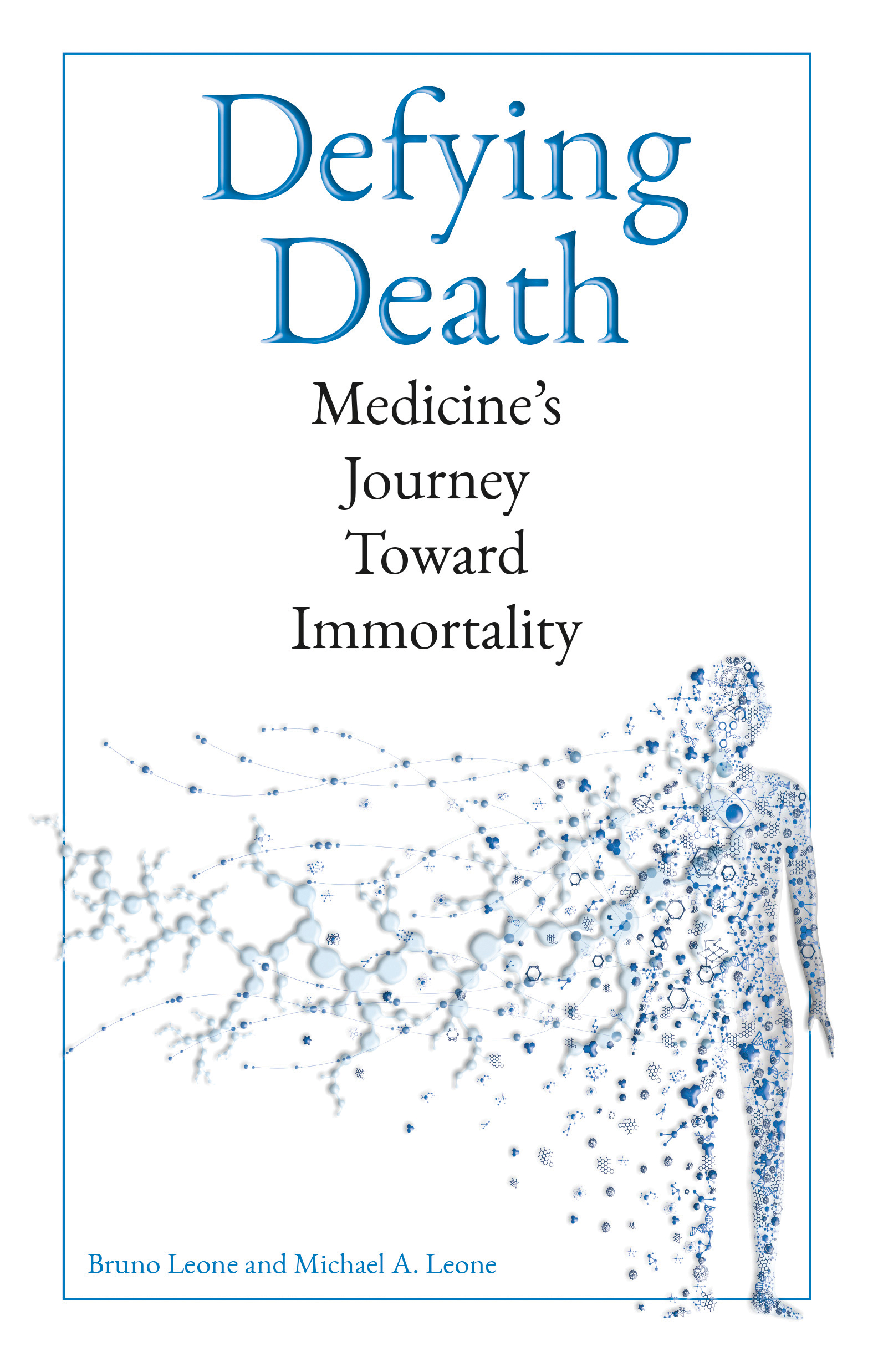
“The book Defying Death: Medicine’s Journey Toward Immortality by the father and son co-authors Bruno Leone and Michael A. Leone is a fascinating mix of history, evidence, and speculation. It starts with the story of the first physicians and ends with what would have seemed science fiction decades ago. Indeed, several current fiction authors fascinate precisely because they transform the human mind into a disembodied being resulting in credible drama. Specialists in aging research have long been skeptical of eternal, ageless life but as the Leones show, that skepticism is eroding under the weight of new evidence. And that is the remarkable value of Defying Death. As the history unfolds the emerging data expands and provides the reader with common sense non-technical language explaining both the information but also its importance. The most compelling human examples are diseases which can be countered by gene editing, amplified by the increasing evidence that genetic (epigenetic) interactions with social, economic, and environmental factors drive premature disease, disability, and mortality. In each of these examples, interventions, be they reactive or preventive, provide both health and wellbeing and result in longer life spans and fewer years of dependency. This is precisely the point the authors make in the opening chapters where they describe the emergence of germ theory and the development of antibiotics and vaccines. This justifies and explains the title of the book. Medical efforts to make life better have progressed to the point where some authors see immortality as the ultimate possibility. And the authors do an admirable job of explaining why. In summary this is an exceptionally informative book in which both anti-aging true believers and skeptics can agree catalogues the relevant information with accessible language. A second volume is sure to come.”

Director of Geriatric Psychiatry
Department of Psychiatry and Behavioral Sciences
Montefiore Medical Center
“A thought-provoking overview on the subject of human longevity. Within the context of history, the authors examine medical science’s ever-growing list of discoveries—from the macroscopic to the microscopic—as though each was woven into a series of pathways leading toward a future of expanding life expectancies. The presentation is penetrating and insightful and dares to consider the question: Will it ever be possible for human beings to live indefinitely?”
Department of Pathology, University of Chicago
“Inherently fascinating, thoughtful and thought-provoking, ‘Defying Death: Medicine's Journey Toward Immortality’ is an exceptionally informative study that will be of particular and special interest to anti-aging believers and skeptics alike will appreciated this compendium of relevant information provided in a thoroughly ‘reader friendly’ organization and presentation. While especially and unreservedly recommended for personal, professional, community, and academic library Health/Medical collections and supplemental Medical Anti-Aging curriculum studies lists, it should be noted for medical students, academia, and non-specialist general readers with an interest in the subject that ‘Defying Death: Medicine's Journey Toward Immortality’ is also available in a digital book format ”
“Over two centuries, U.S. life expectancy nearly doubled, from 40 years in 1800 to 76.9 years in 2000. Credit water filtration, sanitized waste disposal, antibiotics, and vaccinations. Largely through effective use of statistics, the authors show how Alexander Fleming's 1928 discovery of penicillin and Louis Pasteur's immunization of sheep against anthrax dramatically prolonged life. They note that a French woman, who died in 1997, lived to be 122. She is less of an outlier than it might seem: In 2020 the United Nations estimated 573,000 centenarians were alive the world. How much older can people get? Most experts seem to think 150 years will be the upper limit of lifespan (the maximum number of years humans can live before their body organs and systems begin to irreparably fail). To get there will require techniques like CRISPR (a molecular tool to edit out defects in the genetic code that, as the helpful glossary says, stands for “clustered regularly interspaced short palindromic repeats”). The goal is “regenerative” medicine rather than just “repair,” a “wait-until-sick” approach that the authors call a “crude patch.” For now, it can't hurt to practice free, low-tech preventive medicine and exercise, eat healthy and sleep well.”
Booklist, July 2023